

In summary: A new home stage inspection is an independent check of your build at key milestones, from slab to handover. For Melbourne buyers, it is the most practical way to find defects while they are still visible and easy to fix, before the final payment changes hands. This guide explains what each stage covers, whether you can inspect a new build before handover, the most common defects in new homes, and how IBC Property Inspections helps you move in with confidence.
It is a Friday afternoon in Clyde North. After fourteen months of site visits and progress claims, Priya and Daniel are finally walking through their new home with the site supervisor. The paint is fresh, the stone benchtops gleam and the keys are almost in their hands. Everything looks perfect.
What they cannot see is the shower floor that falls towards the bathroom door instead of the waste, the insulation batts missing above the garage, or the torn roof sarking that will let water in during the first winter storm. None of this is unusual. These are exactly the kinds of new build defects Melbourne inspectors find every week, and every one of them is far easier to resolve before handover than after you have moved in.
What Is a New Construction Stage Inspection?
A new construction stage inspection is an independent assessment of your home at a specific point in the build, carried out on your behalf by a registered building inspector. The inspector checks the completed work against your approved plans, the National Construction Code, relevant Australian Standards and accepted workmanship benchmarks, then records any defects in a written report.
In Victoria, stage inspections usually line up with the payment stages set out in the Domestic Building Contracts Act 1995. That timing matters. If a problem is found at frame or lock-up, you can raise it with your builder before the next progress claim is paid, while the work is still exposed and simple to correct.
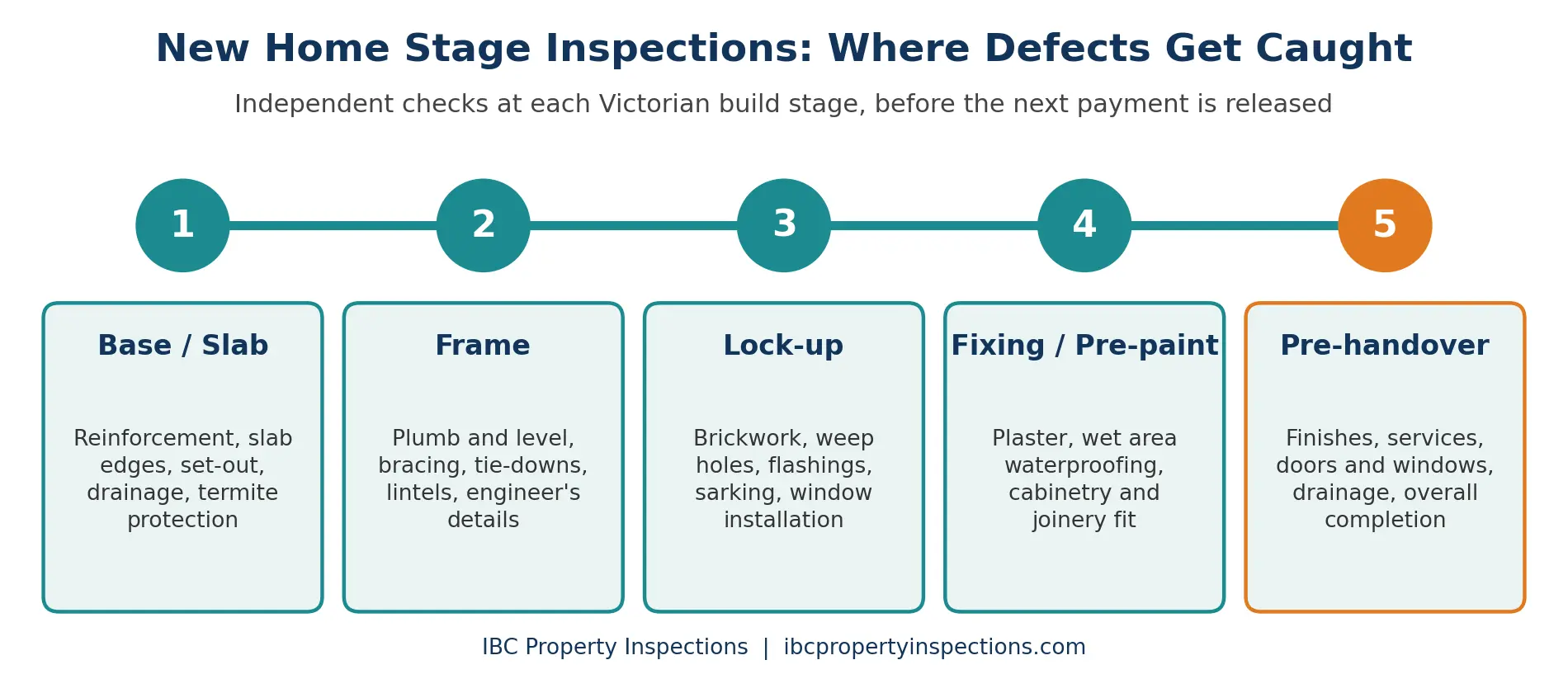
| Stage | When it happens | What the inspector checks |
|---|---|---|
| Base (slab) | Before and after the concrete pour | Steel reinforcement, slab edges, set-out, site drainage, termite protection |
| Frame | Wall and roof frames standing | Plumb and level, bracing, tie-downs, lintels, engineer’s details |
| Lock-up | Cladding, roof, windows and external doors fixed | Brickwork, weep holes, flashings, sarking, window installation |
| Fixing (pre-paint) | Plasterboard, cabinetry and internal doors installed | Plaster finish, wet area waterproofing, joinery fit |
| Pre-handover | Before final payment and key collection | Finishes, services, doors, windows, drainage and overall completion |
At base stage, IBC can also install the GREENZONE® termite management system for your slab.
For a closer look at each milestone, read our stage-by-stage guide to new home building inspections, from slab to handover.
Isn’t the Building Surveyor Already Checking My Home?
Your relevant building surveyor does carry out mandatory inspections at the stages listed on your building permit. The Building and Plumbing Commission’s practice note on mandatory notifications and inspections explains that these checks confirm the work complies with the Building Act, the Building Regulations and the permit at that point. Inspections that an owner arranges for their own due diligence sit outside that process.
In practice, the surveyor’s focus is compliance, not workmanship on your behalf. An occupancy permit confirms the home is suitable to live in; it does not confirm that the paintwork is even, the tiles are level or the doors close properly. An independent inspector answers only to you, which is why new building inspections in Melbourne have become a standard step for careful buyers.
If you are still weighing it up, here is why an independent construction stage inspection is worth having on your build.
Can You Inspect a New Build Before Handover?
Yes, and you should. A pre-handover building inspection takes place once your builder advises the home is complete, but before you sign off, make the final payment and collect the keys. It is your last chance to have defects documented and fixed while the builder is still on the job.
Most Victorian building contracts give owners reasonable access for inspections, but check your contract and give your builder notice. Generally, a builder cannot demand the final payment until the work is complete in line with the plans and specifications and, for a new home, you have received a copy of the occupancy permit. Consumer Affairs Victoria sets out the rules on deposits and progress payments in plain language.
A thorough pre-handover inspection typically covers:
- Internal finishes, including plaster, paint, tiling, joinery and floor coverings
- Doors, windows, locks and hardware, checked for operation and fit
- Wet areas, including falls to floor wastes, silicone seals and signs of leaks
- The roof space, insulation, sarking and visible roof plumbing
- External brickwork, render, cladding, flashings and weep holes
- Site grading and stormwater drainage around the slab
What Are Common Defects in New Homes?
It is common for a brand-new home to have at least a few items to fix at handover. Most are minor, but some can lead to leaks, cracking or costly repairs if they are missed. These are issues our inspectors regularly find across Melbourne’s growth corridors, from Tarneit and Truganina to Cranbourne and Mickleham.
| Defect | Where it shows up | Why it matters |
|---|---|---|
| Poor falls in wet areas | Showers, bathrooms, laundries | Water pools or runs away from the waste, risking leaks and damage |
| Missing or torn sarking and insulation | Roof space, garage ceilings | Water entry during storms and poorer energy efficiency |
| Incomplete flashings, blocked weep holes | Windows, brickwork, roof junctions | Moisture can become trapped in wall cavities |
| Cracked or uneven plaster | Cornices, ceilings, wall joints | Can point to frame movement or poor fixing |
| Poor site drainage | Around the slab and paths | Pooling water can cause movement in reactive soils |
| Sticking doors, misaligned windows | Throughout the home | Often signals frame issues or rushed installation |
Melbourne’s reactive clay soils deserve special mention. Much of the city’s western and northern growth areas sit on clay that swells when wet and shrinks as it dries. Where stormwater is not directed away from the slab, that movement can later appear as cracking in plaster and brickwork. Poor drainage is one of the new build defects Melbourne conditions can make worse over time, which is why we check it at every final inspection.
How IBC Reports Help You Get Defects Fixed
Finding a defect is only half the job; the other half is making sure your builder knows exactly what to fix. Every IBC report includes clear photographs, a plain-English description of each issue and its location, and references to the relevant standard where applicable.
Where workmanship is in question, we refer to the Building and Plumbing Commission’s Guide to Standards and Tolerances, the recognised benchmark for acceptable domestic building work in Victoria. The 2026 edition applies to contracts and work started from 1 August 2026, with the earlier edition covering older builds. Pointing to an agreed benchmark keeps conversations with your builder factual rather than personal.
IBC inspections are led by founder Hetti Pathirana (BSc Eng, MSc), a registered building inspector (IN-PS 74781) and member of the HIA and AIBS. Reports arrive within 24 hours, so you can send your defects list to the builder straight away. If a finding is unclear, we will talk you through it, because our job is to make sure you understand your report, not just receive it.
To choose the stages that suit your build, explore IBC’s construction stage inspection service.
Your Pre-Handover Checklist
- Book your inspection as soon as the builder confirms a completion date.
- Check your contract for site access and final payment terms.
- Attend the inspection if you can, and ask questions on site.
- Send the written defects list to your builder promptly.
- Confirm the fixes before you settle, ideally with a follow-up inspection.
- Keep every report on file in case issues appear later.
Quick Answers for New Home Buyers
Is a new home inspection in Melbourne worth it if my builder has a good reputation?
Yes. Even reputable builders rely on many subcontractors, and busy sites miss things. An independent report gives you an objective record and protects your investment.
Can I still raise defects after I move in?
Yes. Domestic building work in Victoria is covered by statutory warranties, so builders remain responsible for defective work after handover. Issues documented beforehand are usually quicker to resolve, and if your builder will not act, the Building and Plumbing Commission offers a free dispute resolution service.
How long does a pre-handover inspection take?
Usually a few hours for a typical single or double-storey home, depending on its size and complexity.
Book Your New Home Inspection in Melbourne
Handover day should feel like a celebration, not a gamble. Contact IBC Property Inspections to book your stage or pre-handover inspection, and collect your keys knowing exactly what you are signing off on. Call us, email info@ibcpropertyinspections.com or book online today.

Leave A Comment